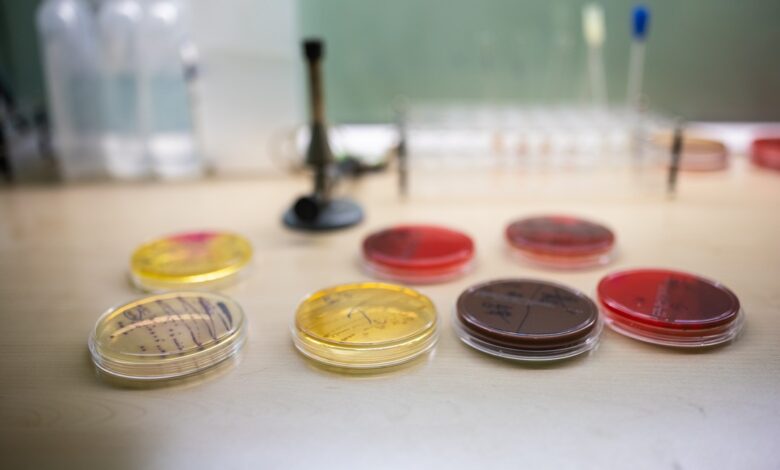
Choosing the right Petri dish matters wherever microbiological inoculation is performed using automated laboratory systems. In manual work, the shape of the side edge may be of minor importance, but a robot must be able to reliably pick up, move, and place the vessel. A grip rim or a smooth surface can therefore affect how the dish interacts with the device’s mechanism.
How do Petri dishes with a grip rim differ from smooth-rim dishes?
Petri dishes are available in various design variants. The differences between them include, among other things:
- diameter,
- height,
- material,
- the shape of the side rim.
This last element affects how the vessel is gripped, transferred, positioned, and opened. In automated processes, its importance is greater because every stage of handling must follow a defined pattern.
Design and functionality of dishes with different rims
A Petri dish with a grip rim has a clearly shaped section of the circumference of the base or lid. It may take the form of a thickening, an undercut, or another profile intended for contact with a gripper. As a result, the mechanism has a defined support point, which makes it easier to pick up and move the vessel stably.
The most important features of this type of plastic Petri dish design include:
- more secure transfer without contact with the working surface,
- reduced risk of the vessel slipping out of the gripper,
- easier positioning on a tray, conveyor, or inoculation module,
- the ability to match the mechanism to a specific profile,
- repeatability during opening, closing, and rotation.
Smooth dishes, by contrast, have a uniform edge without an additional profile. This design may be convenient for manual work, but an automated system must use a different method to stabilize the vessel. Depending on the device design, it may use guides, side clamps, conveyors, dedicated sockets, or vacuum.
Therefore, a smooth dish is not automatically unsuitable for automated inoculation. The key factor remains whether its geometry is compatible with the specific device.
The importance of rim type in automated inoculation
During automated inoculation, a dish may be picked up, positioned, rotated, and transferred between successive modules multiple times. The system may open the lid, dispense the material, spread the sample, close the vessel, and transport it to the next stage. Each of these actions requires the vessel to remain in a stable position.
A grip rim can facilitate integration of the dish with a robot because it creates a predictable contact point. This is particularly important in devices that use mechanical jaws or side guides matched to a specific vessel shape.
If the fit is incorrect, problems may arise such as:
- the dish slipping from the gripper,
- uncontrolled rotation of the vessel,
- incorrect placement at the station,
- difficulty removing or replacing the lid,
- damage to the vessel or contact between the mechanism and the medium.
However, the rim itself should not be analyzed in isolation from the other parameters of the dish. External diameter, base and lid height, material stiffness, dimensional tolerances, lid design, and the way the vessels stack are also important.
The effect of the rim on the precision and efficiency of laboratory robots
A precise grip allows the robot to repeatedly position the dish relative to working elements such as a dispenser, inoculation head, or camera. This matters in processes where the material must be applied or spread in a specific way.
A grip rim can support:
- stabilization of the vessel during transport,
- reduction of shifting and rotation,
- repeatable positioning relative to the workstation,
- more efficient picking of successive dishes,
- reduced need for manual position correction.
How to choose the right type of dish for your laboratory?
The choice of Petri dish type should begin with defining how the laboratory operates and what kind of automation is used. The requirements for a manual station differ from those for a semi-automated system, and these differ again from those for a line in which dishes are automatically transported between successive modules.
Before purchasing, it is worth checking 8 elements.
- Type of automated system – inoculator, sorter, transport system, incubator, scanner, or colony counter.
- Gripping mechanism – jaws, guides, vacuum, or a positioning socket.
- Dish dimensions – diameter, height, and required tolerances.
- Rim design – its profile should match the way the vessel is picked up.
- Lid design – the automated system must be able to remove and replace it correctly.
- Stackability – the stack should remain stable during automated picking.
- Material and stiffness – the vessel should not deform easily during handling.
- Sterility requirements – the method of packaging and preparing the dishes should match the laboratory’s procedures.
A grip rim is particularly useful when the robot uses side jaws or a mechanism designed for a specific vessel profile. A smooth dish, on the other hand, may work well in a system that stabilizes it in another way. The final criterion is therefore the compatibility of the entire setup, not just the appearance of the edge.
Before ordering a larger batch, it is worth carrying out a test on the actual device. This should include the full handling sequence and an assessment of stability during transport, opening, inoculation, and placement. Such verification makes it possible to detect problems resulting from dimensional or design differences before the dishes are introduced into routine use. When selecting vessels, it is also worth consulting their parameters with both the automation system supplier and the dish manufacturer to confirm compatibility between the two components.
Noex Labware offers solutions intended for applications related to microbiology and the automation of laboratory processes. When selecting a specific variant, however, its parameters should always be compared with the requirements of the system in use.
Petri dishes with a grip rim vs smooth-rim models
- A grip rim creates a clear contact point for an automated mechanism and can make stable transfer of the dish easier.
- Smooth vessels can also be used in automation if the device uses an appropriate guiding or gripping method.
- Compatibility is also determined by diameter, height, stiffness, lid design, dimensional tolerances, and stacking method.
- Before implementing a new type of dish, it is worth testing the full operating cycle on the specific automated system.
FAQ
Is a Petri dish with a grip rim necessary for automated inoculation?
Petri dishes with a grip rim make it easier for robots to grip them and reduce the risk of slipping from the gripper. However, some automated systems can also work with smooth dishes, depending on the device design.
Does the type of rim affect how tightly the dish closes?
A grip rim does not directly determine the tightness of the closure. However, it may make opening and closing the vessel easier in certain automated systems.
What are the potential problems when using smooth dishes in automation?
Smooth dishes may be more difficult for some mechanisms to grip precisely. If they are not properly matched, this can lead to shifting, incorrect positioning, and in extreme cases, damage to the vessel.
What should be checked before choosing dishes for automated inoculation?
You should verify the gripping method, vessel dimensions, lid design, stacking method, and the requirements of the specific automated system. Ideally, compatibility should be confirmed during a test of the entire operating cycle.